
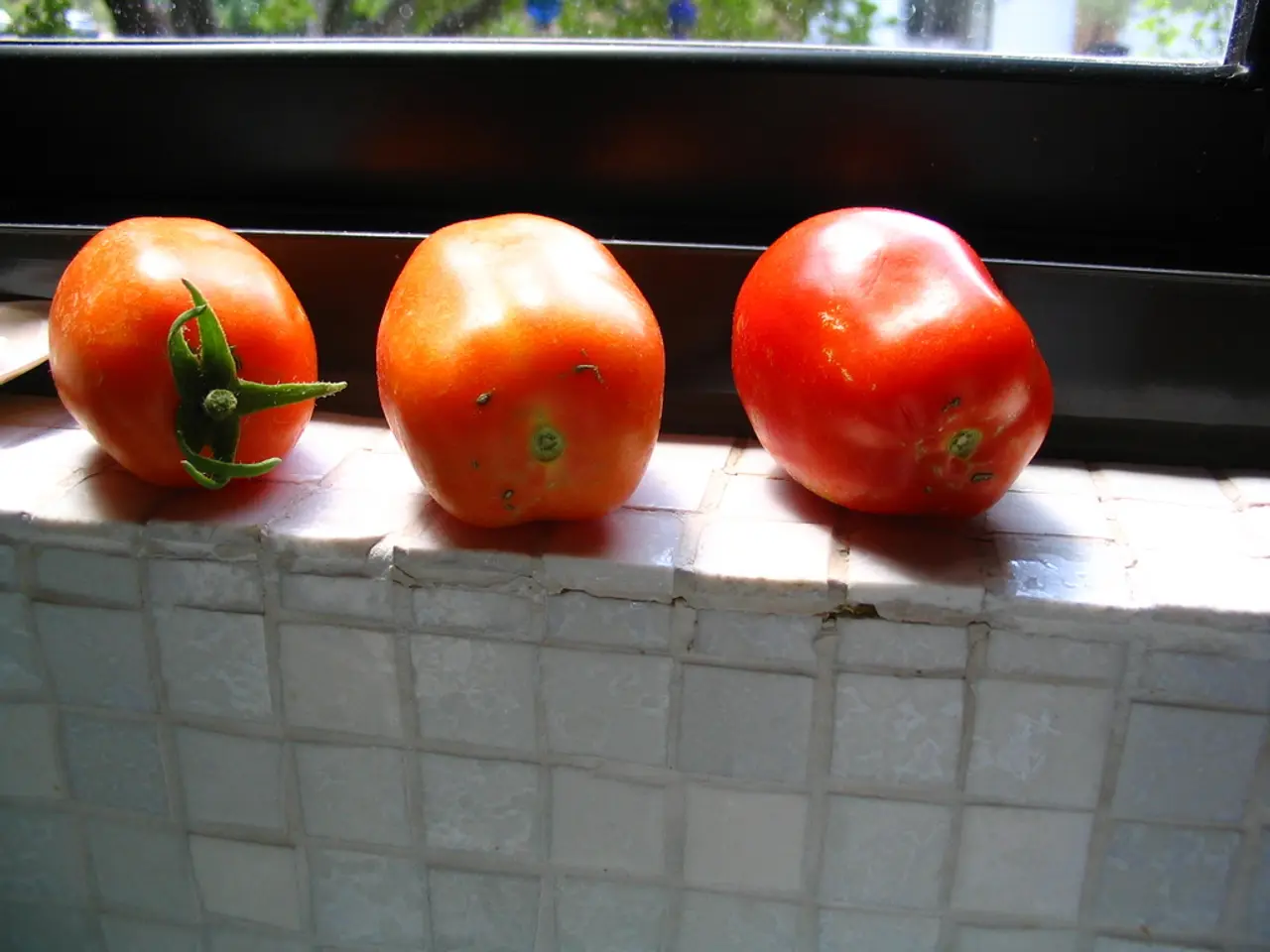
Comprehensive Instructions for Cultivating Tomatoes Within Your Home
In the quest for a bountiful harvest of fresh tomatoes all year round, growing them indoors could be the perfect solution. By following essential steps and providing the right conditions, you can enjoy homegrown tomatoes even during the coldest winter months.
To kickstart your indoor tomato garden, start seeds indoors using quality seeds and a fine-textured, sterile seed starting mix. Plant seeds about 1/4 inch deep, two per cell or pot, and keep the soil temperature between 70-80°F (21-27°C) using a heat mat if possible. Seeds typically germinate in 5-10 days, and they require 14-16 hours of light daily from grow lights placed 2-4 inches above seedlings or a bright south-facing window. Maintain consistent moisture without waterlogging and ensure good air circulation to prevent diseases like damping-off.
Once seedlings emerge, thin them to one per pot after the first true leaves appear. When seedlings have grown for 2-3 weeks and have strong stems, transplant them into larger (3-4 inch) pots with nutrient-rich potting mix. Use containers at least 5 gallons in size with drainage holes to avoid waterlogging, and employ a high-quality, sterile potting mix containing peat, perlite, and compost for good drainage and nutrient content.
Since indoor natural light may be insufficient, supplement with full-spectrum grow lights providing 12-16 hours daily. Maintain daytime temperatures around 65-75°F (18-24°C) and avoid excess humidity or poor ventilation to reduce fungal issues. Water plants regularly to keep soil moist but not soggy, and fertilize with a balanced, water-soluble tomato fertilizer according to product instructions to support continuous fruiting.
To support growing vines indoors, use stakes or cages. Since natural pollinators are limited indoors, hand-pollinate flowers by gently brushing the inside of flowers or shaking plants lightly to help fruit set. Pruning suckers (side shoots) can help the plant focus its energy on producing fruit, but an exception can be made for dwarf varieties, where new plants can be grown from the old root.
By staggering seed starting every 8-12 weeks, you can maintain a year-round supply of tomato plants indoors. Remove any yellowing leaves and prune side shoots to promote airflow and direct plant energy into fruit production. With these conditions, a bountiful harvest of yummy tomatoes can be achieved every year.
Tomatoes can be grown indoors from any variety, not just cherry tomatoes. Heirloom tomato varieties have been grown successfully indoors, and dwarf tomatoes like Tiny Tim are a good choice for a small space. Tomatoes are heat-loving plants that require warm temperatures, with an ideal daytime temperature of 26°C (79°F) and a nighttime temperature of 17°C (62°F). Use an oscillating fan for good air circulation.
Succession planting is a method of planting tomatoes at different times to ensure a continuous harvest. This can be done by starting plants in late winter and growing them all summer, and then starting new plants from cuttings in the summer. Growing in soil indoors can present challenges, but using a good quality tomato potting mix or a homemade Mel's Mix (1/3 compost, 1/3 vermiculite, 1/3 peat moss) can be effective.
For those seeking a cleaner solution, growing tomatoes hydroponically could be an option. A hydroponic system provides the plants with all needed nutrients, using whatever nutrient brand is preferred or available. This method eliminates the need for organic soil and simplifies the growing process.
With the right conditions, a bountiful harvest of tomatoes can be achieved every year, even indoors. Happy growing!
- To prepare your indoor garden, start seeds using quality organic seeds and a sterile seed starting mix.
- Once your tomato plants are strong enough, transplant them into larger pots with nutrient-rich potting mix, using containers that have drainage holes.
- Since indoor light may be insufficient, supplement with full-spectrum grow lights that can provide 12-16 hours of daily light.
- Maintain daytime temperatures around 65-75°F (18-24°C) and avoid excess humidity or poor ventilation to reduce fungal issues.
- To support growing vines indoors, use stakes or cages and hand-pollinate flowers when necessary.
- For a continuous harvest, consider staggering seed starting every 8-12 weeks, or practicing succession planting with new plants from cuttings in the summer.
- If you're seeking a cleaner solution, hydroponics could be an option, as it provides the plants with all necessary nutrients and eliminates the need for organic soil.
- With the right conditions, embrace a lifestyle that incorporates cooking and baking with the fresh tomatoes harvested from your indoor garden, as you enjoy delicious food-and-drink recipes alongside fashion-and-beauty enhancements, all in the comfort of your home-and-garden.